

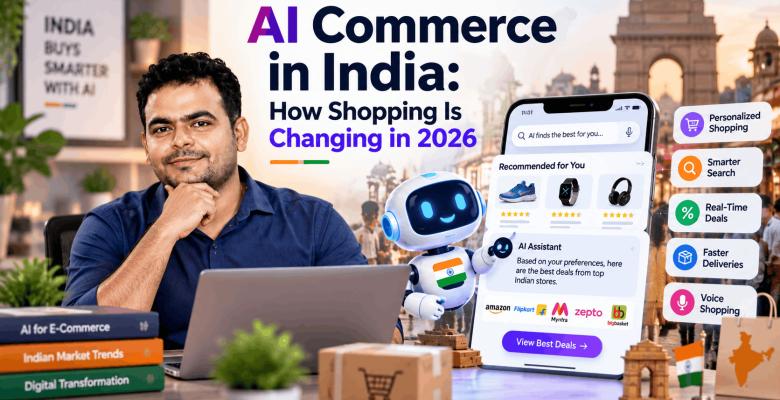
Imagine stepping into a virtual market that knows exactly what you need, sometimes even before you do. This isn't science fiction anymore; it's the reality unfolding across India's e-commerce landscape. By 2026, artificial intelligence is set to transform how millions of Indians shop, turning routine purchases into seamless experiences and complex decisions into effortless clicks.
From bustling metropolises to emerging tier-2 and tier-3 cities, AI is weaving itself into the fabric of everyday commerce. It's quietly reshaping everything from product discovery to delivery, creating a shopping journey that feels less like a transaction and more like a personalized conversation. Let's dive into how this shift is playing out.
The AI Engine Driving India's Shopping Evolution
Indian e-commerce platforms have become laboratories for AI innovation. Algorithms now analyze mountains of data—browsing patterns, purchase histories, regional preferences, and even local trends—to predict what shoppers might want next. This isn't just about showing more products; it's about showing the right products at the right moment.
Consider how search has evolved. Instead of typing exact keywords, shoppers can now describe needs in natural language: "Find me a floral kurta for a summer wedding under ?2,000." AI understands context, regional dialects, and even subtle preferences, delivering results that feel surprisingly human-curated.
Visual search is also gaining traction. Snap a photo of a dress you like, and AI scans thousands of listings to find similar styles. This bridges the gap between offline inspiration and online purchase, especially valuable in fashion-centric markets.
Hyper-Personalization: Your Store, Your Rules
Gone are the days of one-size-fits-all shopping. AI now tailors every touchpoint. When you log into an app, your homepage isn't a generic grid—it's a dynamic display reflecting your unique taste. A student in Bengaluru sees affordable gadgets and trendy sneakers; a homemaker in Jaipur discovers kitchenware and regional handicrafts.
Personalization extends beyond products. Pricing, discounts, and loyalty rewards adapt in real-time based on your engagement. Loyal customers might receive exclusive early access to sales, while hesitant buyers get gentle nudges like limited-time offers. This creates a feeling of being valued, not just targeted.
Even product recommendations have evolved from "customers also bought" to "because you preferred this." AI connects the dots between your behaviors, suggesting items that genuinely align with your lifestyle rather than random add-ons.
Chatbots That Actually Help
Remember clunky chatbots that answered with scripted replies? AI has changed that conversation. Today's virtual assistants understand complex queries: "My order #12345 hasn't arrived. Can you check and resend if lost? Also, suggest similar sarees to the one I returned last week."
Advanced natural language processing allows these bots to grasp frustration, urgency, or ambiguity. They pull data across systems—tracking logistics, accessing return histories, comparing inventory—to resolve issues instantly. For routine tasks, they're often faster than human agents.
The Rise of Agentic Commerce: Your AI Shopping Wingman
Here's where things get revolutionary. Agentic commerce moves beyond assisting shoppers to acting on their behalf. Imagine an AI agent you trust to handle routine purchases. You could say, "Restock my monthly groceries within a ?3,000 budget," and it executes the task—comparing prices, applying loyalty points, and scheduling delivery.
This isn't just convenience; it's delegation. Busy professionals might use agents to manage office supplies. Parents could delegate school uniform replenishment. Even gifting becomes effortless: "Find a thoughtful gift for my mother's 60th under ?5,000. She loves gardening and classical music."
Early experiments in India focus on subscription models (like pet food or diapers) and price negotiation. Agents track price drops across platforms and automatically reorder at the optimal moment. Some even "bid" for vouchers during flash sales, maximizing savings.
For businesses, agentic commerce unlocks loyalty. When shoppers delegate tasks to an AI, switching platforms becomes inconvenient. This creates sticky relationships built on trust and efficiency.
Challenges on the Road to AI-Powered Shopping
While the potential is immense, adoption faces hurdles. Privacy remains a top concern. Shoppers need transparency about how their data trains AI models. Platforms must balance personalization with intrusiveness—recommending a pregnancy test because someone browsed baby clothes can feel invasive.
Accessibility is another frontier. For AI to benefit all Indians, interfaces must work seamlessly in regional languages and on low-bandwidth networks. Voice assistants need to grasp diverse accents; visual search must recognize local products.
Then there's trust. Convincing users to let AI agents make purchases requires flawless reliability. A single error—like ordering the wrong medicine—could shatter confidence. Robust verification systems and clear accountability frameworks are essential.
What 2026 Holds for Indian Shoppers and Sellers
By 2026, AI won't just support shopping; it will reshape the ecosystem. Expect these key shifts:
- Blurred Lines Between Online and Offline: AI will power unified experiences. Scan a product in-store to see online reviews; order online for in-store pickup with personalized promotions waiting.
- Predictive Logistics: Delivery networks will anticipate demand surges. If AI spots rising interest in umbrellas across a city, warehouses pre-position stock before the monsoon hits.
- Small Business Empowerment: Vernacular AI tools will help local artisans and kirana stores build digital storefronts, manage inventory, and reach wider audiences without tech expertise.
For shoppers, the biggest win is time. Tedious tasks—comparing prices, tracking deals, reordering essentials—will fade into the background. Shopping becomes about discovery, enjoyment, and connecting with brands that feel like partners.
For sellers, AI levels the playing field. Data-driven insights help small players compete with giants. Hyper-localized demand forecasting reduces waste and boosts margins.
A Future Crafted by Intelligence
The soul of Indian shopping—bargaining, discovering hidden gems, building relationships—won't disappear. Instead, AI removes friction, letting us focus on what matters. By 2026, shopping in India will feel less like browsing a catalog and more like having a savvy, always-available friend guiding your choices.
This transformation isn't just about efficiency; it's about creating commerce that’s responsive, inclusive, and genuinely helpful. As AI matures, the winners will be those who embrace it not as a tool, but as a collaborator in crafting better experiences for every Indian shopper.

Discussion & Feedback