

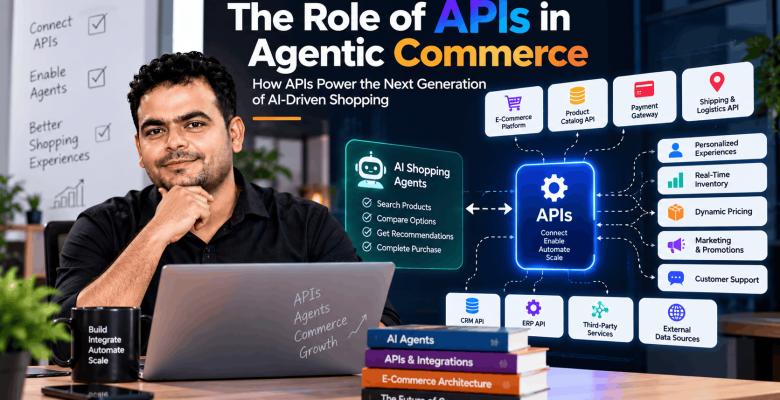
Introduction to Agentic Commerce
Agentic commerce represents a paradigm shift in e-commerce, where autonomous AI agents perform complex transactions, negotiations, and customer interactions. These agents require robust, real-time connectivity with diverse systems—a role fulfilled by application programming interfaces (APIs). In this ecosystem, APIs act as the essential conduits enabling data exchange between AI agents, e-commerce platforms, payment gateways, and inventory management systems.
The Backbone: APIs in Agentic Commerce
APIs serve as the foundational infrastructure for agentic commerce, allowing AI agents to programmatically access and manipulate e-commerce functions without human intervention. For instance, an AI agent might use a product catalog API to retrieve real-time pricing, then leverage a shopping cart API to reserve items while negotiating with a customer via a chatbot API. This decoupled architecture enables scalability, as new services can be integrated without disrupting existing workflows.
Key Types of APIs Powering Agentic Commerce
E-commerce APIs
Traditional e-commerce APIs—such as RESTful endpoints for product search, cart management, and order processing—form the operational core. These interfaces allow AI agents to execute tasks like fetching dynamic inventory levels or applying personalized discounts. For example, an agent might combine a payment API with a loyalty points API to suggest optimal redemption strategies during checkout.
AI Agent APIs
These specialized APIs facilitate machine-to-machine communication between AI agents. They standardize protocols for negotiation (e.g., offer/counteroffer sequences), delegation (passing tasks between agents), and collaborative decision-making. A supplier agent might use a procurement API to bid on bulk orders from a retailer agent, with both agents autonomously validating terms via smart contract APIs.
Building the Infrastructure: Agentic Commerce API Ecosystems
Successful agentic commerce requires an orchestrated API ecosystem. This involves:
- API Gateways: Manage authentication, rate limiting, and routing for high-volume agent requests.
- Event-Driven Architectures: Use webhooks or messaging queues to trigger real-time actions (e.g., notifying agents of inventory changes).
- Semantic Layer APIs: Translate business logic into agent-executable commands, abstracting underlying system complexities.
Developers should prioritize idempotency in API design to handle duplicate agent requests and implement OAuth 2.0 for secure inter-agent authentication.
Integration Challenges and Best Practices
Integrating APIs for agentic commerce introduces challenges like endpoint fragmentation, inconsistent error handling, and latency bottlenecks. Mitigate these by:
- Adopting unified API specifications (OpenAPI) for consistency.
- Implementing circuit breakers to prevent cascading failures during peak loads.
- Using GraphQL for efficient data fetching, reducing payload sizes when agents query multiple systems.
Log all agent interactions via audit APIs to ensure traceability and compliance.
Future Outlook
As agentic commerce matures, expect standardized protocols for cross-platform agent interoperability and increased adoption of WebAssembly for edge-based API execution. APIs will evolve from passive data pipes to active participants, incorporating embedded AI for real-time request optimization.

Discussion & Feedback